

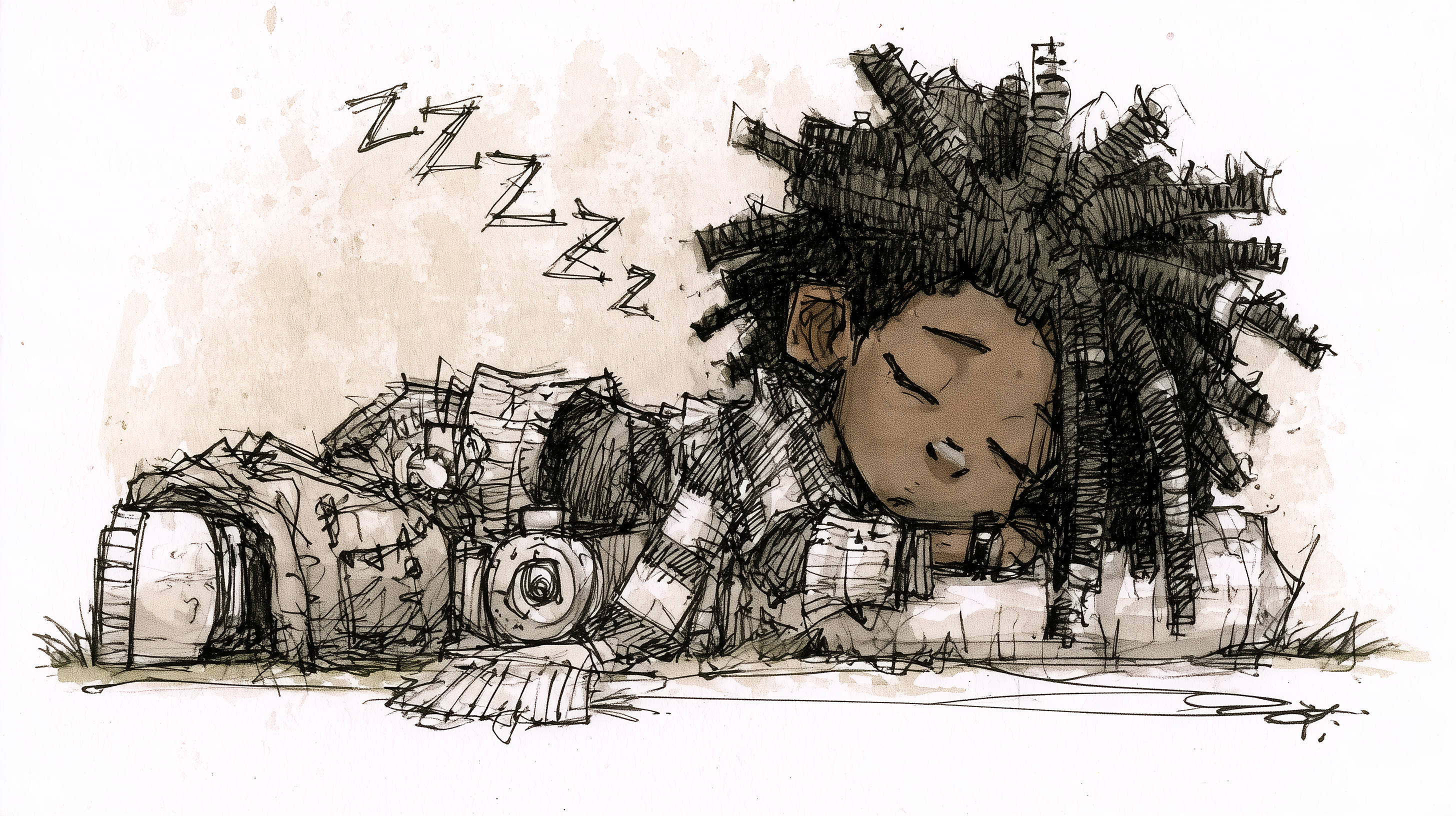
A note before we start: more research needs to be conducted on adult dyslexia to validate or invalidate my working knowledge. What I know is from lived experience and personal research. My objective is not to change the body of research but to instigate the conversation that will lead to it.
The other night my wife and I were getting ready to go to sleep when I asked her a seemingly simple question about waking up. “Babe, when you get up in the morning does your brain treat you like a kid that talks too much and too fast?” With a chuckle she replied, “No, my brain is telling me to stay in bed but my body is saying it’s time to get up. Why?” Our conversation went on for a little, then we both slowly stopped speaking and said our goodnights.
What she didn’t realize, or has just gotten used to, was me lying there silently for another hour awake. I heard her breathing change, felt her body relax into sleep, and eventually drifted off to another night of intermittent sleep. In addition to dyslexia, which may affect my sleep too, I also have PTSD, which really does mess with my sleep. The years I didn’t dream have become the best years for my sleep, because when I do dream I wake up and still feel like I’m dreaming. Sleep science has connected sleep deprivation to hallucination, but this isn’t what I am experiencing.
What I wake with is a hyperactive mind. I’m a lucid dreamer who wakes four to five times a night, and I suspect many of those wake-ups happen in REM sleep, since I often wake still feeling like I’m dreaming. I haven’t confirmed this with a sleep study or a tracker. Figuring this out is part of the new journey of building a logic-fence around my dyslexia, so I know what’s actually impacted and what’s an excuse. Knowing this is critical for me. I need to understand how to identify when, where, and how this mental handicap shows up. Knowing this, I can build better checks-and-balances for written and oral communication.
This is where “correlation does not imply causation,” self-fulfilling prophecy (expecting a problem can help create it), and even the Baader-Meinhof phenomenon (once you learn something, you start seeing it everywhere) all have distinct and meaningful swim lanes. It’s these silos that help me compartmentalize adult dyslexia, which is why this journey of explaining is meaningful. Dyslexia is woefully understudied in adults. Part of me wonders if that’s because we have developed compensating techniques that help us blend in, or if we are just too ashamed to ask for help.
The more that I learn, the more questions I have. It seems like this is a never-ending cycle that is empowering, humiliating, calming, and frustrating all at once. It’s empowering because I can now identify when I’m drifting and insert social engineering techniques to back out of the situation. I can use negotiating strategies to help with framing and reframing, but I am just learning how to address the most important thing: sleep.
Early sleep studies, mostly in children, suggest the sleep spindles in people with dyslexia are not the same as in people without it. This raises two important questions:
- What are sleep spindles?
- What do normal sleep spindles do?
Sleep spindles are sudden, intense bursts of rapid brain activity (oscillating at 11 to 16 Hz) that last between 0.5 and 3 seconds. They show up most in Stage 2 NREM sleep, the lighter stage before deep, slow-wave sleep, and they keep firing as you go under. Research suggests that in a typical brain they do two things. The first is that they may help block out noise so you can sleep. That may be why you can sleep at a beach. Well, you have to block out the bright sun, but the sleep spindles may handle the noise. The second is that they appear to tag short-term memories and data gathered throughout your day in the hippocampus and help transfer them to the neocortex to be filed away into long-term storage (Diekelmann & Born, 2010).
Almost everything I’m about to say about spindles and dyslexia comes from small studies, mostly in children, because the adult research barely exists yet.
Research suggests that sleeping after learning helps lock in new information, and spindles appear to play a role. In some samples, people with dyslexia show fewer or atypical slow spindles. My working theory, which is not scientifically proven, is this. In a typical brain, spindles show up in an orderly manner, all presenting information to keep or discard like a waiter walking around with hors d’oeuvres. In a brain like mine, it feels like closing my eyes and opening them with all the food coming at me at the same time. Combine this with PTSD, and sleep never really feels like sleep.
In a normal situation this is a problem. In the world of tech, where things move faster than anyone can keep up with, losing the capacity to learn at a speed that keeps up with your peers is not just a handicap, it’s a liability. This is not scientifically proven, but it’s a consistent trait I see in other dyslexics: mental tenacity. Whether intentional or not, every dyslexic I’ve met refuses to be left behind. That’s what I’ve seen in the people who ended up in my life, not something anyone has measured. ADHD and dyslexia frequently co-occur, so if you have one, it’s worth asking about the other.
Dyslexics also tend to be the “jack of all trades” friend in the group because peripheral learning as a self-education technique is common. Peripheral learning is when you study the things related to a focus topic and learn the focus topic as a byproduct. It takes longer but often leads to deeper understanding and amazing trivia skills. My working theory is that when I flood the system, the spindles have more versions of the same information to sort. The immediate recall of the core topic isn’t there, but the related information is.
If you work with a dyslexic, the best way to really understand their depth of knowledge on a topic is to make it a low-pressure conversation, or be blunt with what you want and let them talk their way through it. They will make several passes and close the conversation with a summary that has more depth than you may be ready for.
Many statements in this post are not clinically backed; they come from lived experience. Through the past year of research I have conducted, I’ve learned:
- Federal special education law has only existed since 1975 (Education for All Handicapped Children Act, Pub. L. 94-142).
- The term neurodiversity dates to 1998 (Singer, 1998; Blume, 1998), and neurodivergent came along around 2000.
- As of now, from what is publicly available, Hawaii is the only US state without a dyslexia-specific law.
- Corporations don’t know how to help employees with mental handicaps.
- I strongly dislike the categorization of neurodiverse and neurodivergent.
- Neurodiverse comes off as if I have multiple neurologies.
- Neurodivergent comes off like I am neurologically diverted and will continue to be “off-course,” and more so with age.
- Mental handicap is more acceptable to me because it admits that there are times I need a little more help, but overall I’m capable.
- Dyslexia is still too often treated as a childhood learning disability, and research and resources for adults are thin.
- Standard education, technical certifications, and more are not fit for purpose with dyslexics.
- Early research suggests sleep is impacted by dyslexia.
- In my experience, dyslexia sometimes gets tagged as dyscalculia or autism, and the dyslexia is what gets overlooked.
- In my experience, dyslexia impacts verbal communication.
- In my experience, dyslexia impacts emotional processing.
The most detrimental item on that list is the lack of research and resources to help adults with dyslexia. Employment self-identification of having dyslexia is frequently under-reported because adults don’t know they have it. It wasn’t until my daughter was diagnosed with dyslexia that I understood I had it. I learned more from her special education than I did in my whole life. The tools didn’t match, but I retrofitted them to suit me.
I was fortunate enough to be open to learning so much about my daughter that I learned about myself. Retrofitting her tools to fit me is a “me” thing. I cannot say how many are like me, and neither can the researchers.
If this was helpful to you, I am grateful. I share this because I have personally lost so much to this stealthy handicap that I cannot sleep knowing that I know something that can help others. Maybe that’s why my sleep spindles are over-saturating me… I am helping myself and hoping to help others, so my sleep is secondary to my mission. Nah, it’s dyslexia.
References
Blume, H. (1998, September 30). Neurodiversity. The Atlantic.
Diekelmann, S., & Born, J. (2010). The memory function of sleep. Nature Reviews Neuroscience, 11(2), 114–126. https://doi.org/10.1038/nrn2762
Education for All Handicapped Children Act of 1975, Pub. L. No. 94-142, 89 Stat. 773.
Hu, E. H., Sayeski, K. L., & Morgan, P. L. (2025). Assessing the impact of dyslexia laws on identification and reading achievement: An empirical analysis. Annals of Dyslexia, 75(3), 637–654. https://doi.org/10.1007/s11881-025-00347-w
Reda, F., Gorgoni, M., D’Atri, A., Scarpelli, S., Carpi, M., Di Cola, E., Menghini, D., Vicari, S., Stella, G., & De Gennaro, L. (2021). Sleep-related declarative memory consolidation in children and adolescents with developmental dyslexia. Brain Sciences, 11(1), 73. https://doi.org/10.3390/brainsci11010073
Singer, J. (1998). Odd people in: The birth of community amongst people on the autism spectrum [Honours thesis]. University of Technology Sydney.
Solbi, A., & Earle, F. S. (2025). The role of sleep in memory consolidation and reading in dyslexia. Journal of Cognitive Neuroscience, 37(3), 532–542. https://doi.org/10.1162/jocn_a_02282
Youman, M., & Mather, N. (2013). Dyslexia laws in the USA. Annals of Dyslexia, 63(2), 133–153. https://doi.org/10.1007/s11881-012-0076-2
Youman, M., & Mather, N. (2015). Dyslexia laws in the USA: An update. Perspectives on Language and Literacy, 41(4), 10–18.
Youman, M., & Mather, N. (2018). Dyslexia laws in the USA: A 2018 update. Perspectives on Language and Literacy, 44(2), 37–41.
Discovered during writing
Georgan, W. C. (2026). Analyzing state dyslexia legislation through the lens of oral language: An exploratory study. Annals of Dyslexia, 76(2), 252–266. https://doi.org/10.1007/s11881-026-00380-3 Georgan (2026) examines state dyslexia legislation through the lens of oral language, which bears on the legal claims in this piece.
McSorley, A., & Earle, F. S. (2026). Memory consolidation in adults with and without developmental language disorder and dyslexia. International Journal for Research in Learning Disabilities, 18. https://doi.org/10.28987/ijrld.9.1.18 McSorley & Earle (2026) tested overnight memory consolidation in young adults with and without developmental language disorder and dyslexia, and it is the closest thing I found to adult sleep-related data. It does not measure spindles, and its participants are young adults, so it supports the question without answering it.
Leave a Reply