

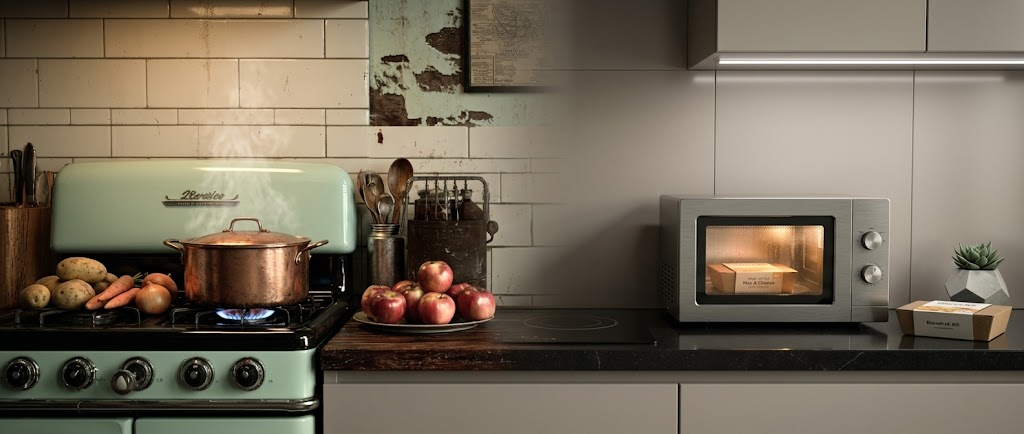
Do you still cook family dinners every night?
There is a very strong chance you’ll respond to that with no. Frankly, you’re not alone, and more important than that is this; you’re not a bad parent, or partner, or spouse if you don’t. Home cooked meals are time consuming. With the super majority of homes needing two or more incomes, we have become time poor. Saying this I understand my home is statistically an anomaly.
Between my wife and I we cook our meals from scratch about six nights a week. Sitting on the high horse of being a home that makes meals nightly is not a complete story. Even though we cook as much as we can there are nights when it’s a takeout or fend-for-yourself night. We cook as much as we can because it’s more cost effective, we can control the quality of our foods, but most of all, we aren’t going to have the kids home forever. Doing this gets us talking, laughing, or at the minimum together without phones.
The average global household that does eat at home will spend less time cleaning up after the meal than eating or making it. The average American spends just 37 minutes on food preparation and cleanup combined. The wild part is that they spend about an hour actually eating. When you spend less time making and cleaning something than consuming it, the math tells you what is on the table. You are not cooking, you’re doing the “heat and eat.”
The amount of homes that start a meal from raw ingredients to a finished dinner… yeah, you’re looking at a cliff. The more problematic reality is this… whole classes of people are not calculated in the statistics. Growing up on the battlegrounds of the American hood I only had Mormons, Jehovah’s Witnesses, and superintendents knocking on my door. There were no pollsters at the corners, or downtown. If they were there, no one was talking to them. How do you account for those families and whether they do or do not cook meals from scratch?
Programs like WIC and food stamps in America give money to homes that fall below an income bracket, but it doesn’t track what meals are made or who is at the dinner table as a result of that money. Stores accepting those payments often times will use the payment system for non-food items. Even more troubling is the fact that a large majority of inner cities are categorized as food deserts.
A food desert, as defined by the United States Department of Agriculture, is a low-income census tract where at least 500 people or 33 percent of the population live more than one mile from the nearest supermarket, supercenter, or large grocery store in an urban area. Low income in this context means a poverty rate of 20 percent or greater, or a median family income at or below 80 percent of the surrounding area’s median. By that measure, approximately 19 million Americans, roughly 6 percent of the total population, live in areas that qualify as both low income and low access. What the definition does not capture, and what no federal program currently tracks, is what happens inside those homes at dinnertime. The USDA can map the distance to a grocery store. It cannot map whether anyone is standing at a stove.
The term food desert has drawn criticism from researchers and community advocates who argue it implies a natural, barren landscape rather than naming what it actually is: a deliberate outcome of economic segregation, the migration of supermarket chains to affluent suburbs, and decades of disinvestment in low-income urban neighborhoods.
The word desert suggests emptiness. What it actually describes is abandonment. Those are not the same thing, and the distinction matters when you are trying to understand why the scratch kitchen disappeared from the neighborhoods that arguably needed it most. More than half of all calories consumed at home by American adults now come from ultra-processed foods, a number that has been climbing steadily since 2003.
The scratch kitchen is not in decline. It is statistically rare. Of the roughly 49% of Americans who cook dinner at home six to seven nights per week, only a fraction are doing so from raw ingredients. The majority of “home cooked” meals in that group involve packaged, pre-made, or minimally prepared components. Working from a raw ingredient to a finished plate now places a household in approximately the top 10% of American homes by cooking behavior. Not by income, not by education, not by any other measure. Just by what happens between the refrigerator and the table.
Even more striking is the demographic. Globally, immigrant homes are more likely to be the ones cooking at home and more likely to be cooking from scratch when they do. Foreign-born parents share frequent dinners with their children at a measurably higher rate than native-born parents, a gap that has held consistently since 2018; the frequency number alone understates the difference.
The more telling data point is in what disappears over time. Research on dietary acculturation shows that as immigrants spend more time in the United States, they consume progressively more processed food and fewer whole ingredients, a documented generational erosion that researchers have named the healthy immigrant paradox. The first generation brings the table. The second generation negotiates with it. By the third, the scratch kitchen is largely gone. Foreign-born and first-generation Latinos typically maintain strong preferences for traditional cultural foods. Second-generation Latinos show a measurable shift away from them.
Family dinner decline — Belgium, United States, Japan
All three datasets indexed to 100 at each country’s earliest measured point. Y-axis reflects rate of decline, not absolute values. US generations mapped to approximate midpoint year of each cohort’s childhood.
Indexing: Belgium baseline = 1966 (1.56 meals/day = 100) · US baseline = Silent Generation ~1950 (84% = 100) · Japan baseline = 1960 (~92% = 100). Indexing allows directional comparison only — underlying metrics differ by country.
US year mapping: Silent Gen → 1950 · Boomers → 1970 · Gen X → 1985 · Millennials → 2003 · Gen Z → 2018.
Japan: 1960 and 1975 are research-derived estimates. 1990 estimated from qualitative academic record. 2005 inferred from Shokuiku Basic Law enactment. 2023 is the most recent measured national survey snapshot. Treat pre-2005 Japan points as directional.
Sources: Mestdag & Glorieux (2009), Sociological Review · U.S. generational survey data · Japan government food education surveys / Nippon.com
Immigrant homes account for more of the home cooked meals because the kitchen is doing something the restaurant cannot. It is rebuilding, one meal at a time, a home that no longer exists at a geographic address. The food is not just nourishment. It is evidence. Evidence that the place you came from was real, that the people who taught you to cook were real, and that the distance between here and there has not yet made you forget either.
82.6% of immigrant homes are two parent homes where there are children included as part of the survey. I am not breaking these numbers down into categories because I am focusing us on the intentionally dismantled family dinner. The clearest proof of this is not racial, it’s financial. The more well-off a home becomes the more intentional the heads of that home must be in keeping the family dinner going.
Well-off is the means to have a better quality of life, it means that you’ve made it to a better financial situation. Being well-off feels like eating out and enjoying the food because it’s good, not because you consider it to be expensive. Putting a timeless amount of wealth is unrealistic. Things like inflation, exchange rates, and general costs of living can make numbers seem like wealth, but when 2,200 of a given currency only buys one ice cream scoop of rice that number means nothing.
My grandmother was born March 31st, 1923. When she was a child food was picked from the garden or bought from a stand. The vegetables or fruits sold were farmed somewhere in walking distance and were no more than two or three days away from when they were picked. Meats came from a butcher, and the animals were all free roaming, fed from the grass or local environment.
Cooking meals was a necessity. Canned foods in her youth were not trusted. She still calls a refrigerator an icebox and tells stories of how the man who sold ice would cut off the amount they needed for their icebox. She raised all of her children with a mantra she passed to me as well. “The house is alive, the kitchen is the heart, and the family is it’s soul.” In her home only my grandfather didn’t eat at the dinner table, but only when the Yankees were playing. Any other time, Pops sat at the head, and she sat at the other end with the children between.
My wife’s family had a similar setting. Even though we are culturally dissimilar we are identical in how we close our days. The dinner table is where we share our memorable moments, make lifelong memories, get reprimanded, or come together as a family to support whoever is dealing with a difficult time. As the world speeds up the dinner table is the one slow down that doesn’t slow us down. It takes intention, it takes time, and at times a burned meal is a scramble for something to eat that isn’t if we can afford it. If not, then eating that burnt meal becomes a story we’ll laugh over tomorrow we’ve all been called to stop whatever we’re doing alone to come together.
Home cooking tastes different because it is not just food for your gut, it is nourishment for your soul. Soul food, if you would.
Leave a Reply